EARTHMARKET
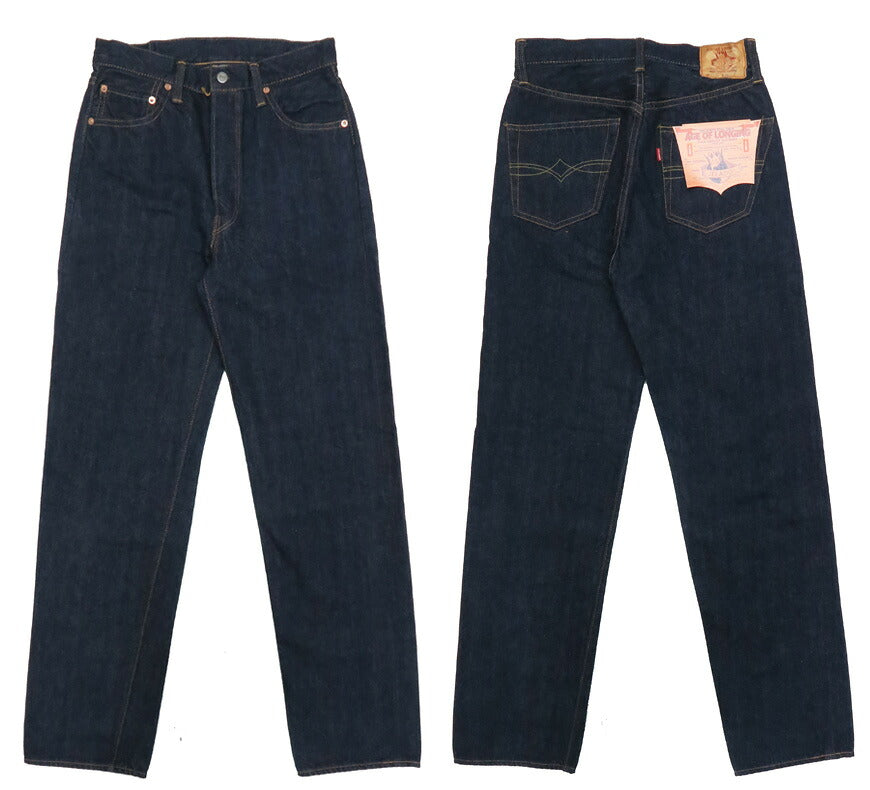
JELADO 14oz Denim Jeans Age of Longing 301XX Regular Straight LAST RESORT One Wash JP94301
JELADO 14oz Denim Jeans Age of Longing 301XX Regular Straight LAST RESORT One Wash JP94301
Regular price
¥33,000 JPY
Regular price
Sale price
¥33,000 JPY
Unit price
per
Tax included.
Shipping calculated at checkout.
Couldn't load pickup availability
■JELADO STANDARD COLLECTION Age of Longing 301XX 14oz Denim Jeans Regular Straight
 Model Height 175cm, Weight 60kg, wearing size 30 inches Looking back at JELADO's 15-year history, we thoroughly pursued "denim," which was the first thing we tackled. We selected the cotton that is the source of production from scratch. The Age of Longing 301XX started with the desire to once again create high-quality, meticulously crafted denim. We disassembled a DEADSTOCK Levi's 501XX fabric from the early 1950s, meticulously selected American cotton, and scientifically reproduced a 14oz denim fabric by analyzing the yarn thickness, fiber length, and number of twists at a national testing institution. Based on data that analyzed everything from the indigo color to the number of threads per inch, we named this reproduced fabric "LAST RESORT," attached an original tag, and engraved "XX" on the leather patch. <Age of Longing 301XX> To finish this meticulously crafted fabric with the same passion, we commissioned a Japanese factory that used to sew for a famous jeans brand, asking them to use the same sewing specifications as JELADO's vintage pieces. We replicated everything from the type of thread, the stitch count for each part, and even the irregular specification of using a different sewing thread for just one belt loop. We made numerous fine adjustments to ensure the sizing was also true to vintage dimensions. We re-examined and meticulously reproduced the 501XX of that era, including the fabric direction, sewing method, and stitch length. The leather label is also different from a normal leather label, using horsehide with an uneven surface texture and applying a rubbed-like red print. This leather patch, with its noticeable rough surface, shows blurring and bleeding in the print, allowing each piece to have a unique vintage feel. To match the denim, which is infused with the utmost passion in every aspect – thread, dye, fabric, and sewing – all accessories have also been renewed. We produced iron tack buttons and two types of original solid copper rivets. The hidden rivets also replicate the size of the 501XX, a design not usually found. All components are manufactured to be identical to the specifications of that time. <About LAST RESORT> The 501XX is said to be woven with #7 warp and #6 weft yarns. In the pre- and post-1950s America, spinning technology was not yet stable. Upon disassembling and analyzing vintage deadstock, it was found that there were deviations in yarn thickness down to the decimal point depending on the individual piece. The yarn used to weave this original denim has been reproduced down to the decimal point based on the analysis results. Yarn count numbers increase as the yarn gets finer. The calculation method defines 1 hank of yarn as 1 pound (approx. 454 grams) and 840 yards (approx. 768 meters) long. A yarn twice the length (1680 meters) is count #2, and three times the length (2520 meters) is count #3. As the number increases, the yarn becomes finer, making it possible to reproduce yarn counts down to the decimal. Therefore, it was understood that to reproduce this fabric, the yarn thickness had to be created from scratch, leading to the selection of cotton and the creation of original weaving yarn. The 501XX used yarns with completely different fiber lengths for the warp and weft; medium-staple cotton for the warp and extra-long staple cotton for the weft. To reproduce this denim, we meticulously selected American cotton as close as possible to the fiber length of the time, believing it was the same cotton used back then. Cotton can vary depending on the cultivated region; long-staple cotton is grown in warmer areas, and short-staple cotton is grown in colder areas. America has areas suitable for both, allowing for the cultivation of cotton that brings out the characteristics of both. This is why we were able to focus on American cotton with a fiber length close to the yarn of that time. For the warp, we used EMOT (Eastern, Memphis, New Orleans, Texas) cotton, which is a blend of cotton from near Memphis. For the weft, we used Pima cotton cultivated in California. We also reproduced the yarn twist coefficient, successfully recreating the same yarn as back then. For dyeing, the spun raw yarn first undergoes a process called warping before dyeing. In this process, 600 to 900 raw yarns, approximately 6000 yards (about 5,486m) long, are bundled into a rope and wound cylindrically. The equipment used for this process was independently developed by a certain company. After warping, the raw yarn is dyed with indigo dye using the rope dyeing machine, which was successfully developed for the first time in Japan. The pure white raw yarn passes through multiple indigo dye baths and is squeezed by rollers. Initially, it appears a vivid green, but as it is hoisted high, it oxidizes upon contact with air, gradually changing to an indigo blue. By adjusting the indigo dye mixture, the time exposed to air, and the yarn tension, various shades of indigo can be expressed. It also allows for the core-white effect (where the core of the yarn is not dyed), which is essential for the unique fading of jeans. Adjusting each machine requires the skilled technique (craftsmanship) of experienced operators. Afterward, the indigo-dyed warp threads are sized and finished, and finally shipped to the weaving factory (hataya) where the fabric is actually woven. The commitment to weaving involved scientifically analyzing the 501XX of that time, reproducing exactly the same yarn, i.e., yarn of the same specifications, and weaving it. To achieve thorough craftsmanship, this was done under the guidance of skilled artisans capable of weaving to the precise thread count, using the TOYODA G3 power loom, which is said to have been the first to operate in Japan. Furthermore, the selvage was also reproduced by disassembling vintage pieces, dyeing it the same red ear color as back then, and investigating and reproducing the number of threads running left and right from the center of the red ear. Even parts other than the denim fabric have been meticulously reproduced. Through these numerous processes, the "LAST RESORT" fabric, which was the 501XX fabric of that time, has been reproduced.  JELADO was founded in 2004. Based on "AMERICAN VINTAGE" born more than half a century ago, we elevate them to modern fashion. All products are manufactured in Japan. This is because Japan is the only country in the world that can give form to the exquisite nuances and thoughts intended during the planning stage. 
 At the time, to improve work efficiency, pockets of the same shape were attached without distinction between left and right. Therefore, the back pockets are not symmetrical and have this distorted, unique look.  

 Size Details Click here for how to measure sizes. Material 100% Cotton 14oz Denim Color One Wash Remarks Since it is pre-washed, it will not shrink further. Sizes are measured actual and average values are listed. Please note there may be slight individual differences. About the Product Many of our products are designed based on vintage items. To emphasize their authenticity, there may be slight irregularities in stitching, fabric color, texture from processing, and uneven coloration. Please understand these as part of the product's charm. Additionally, product specifications (stitching, parts, color, size, etc.) may change without notice. We hope you will enjoy these items with the above points in mind. |